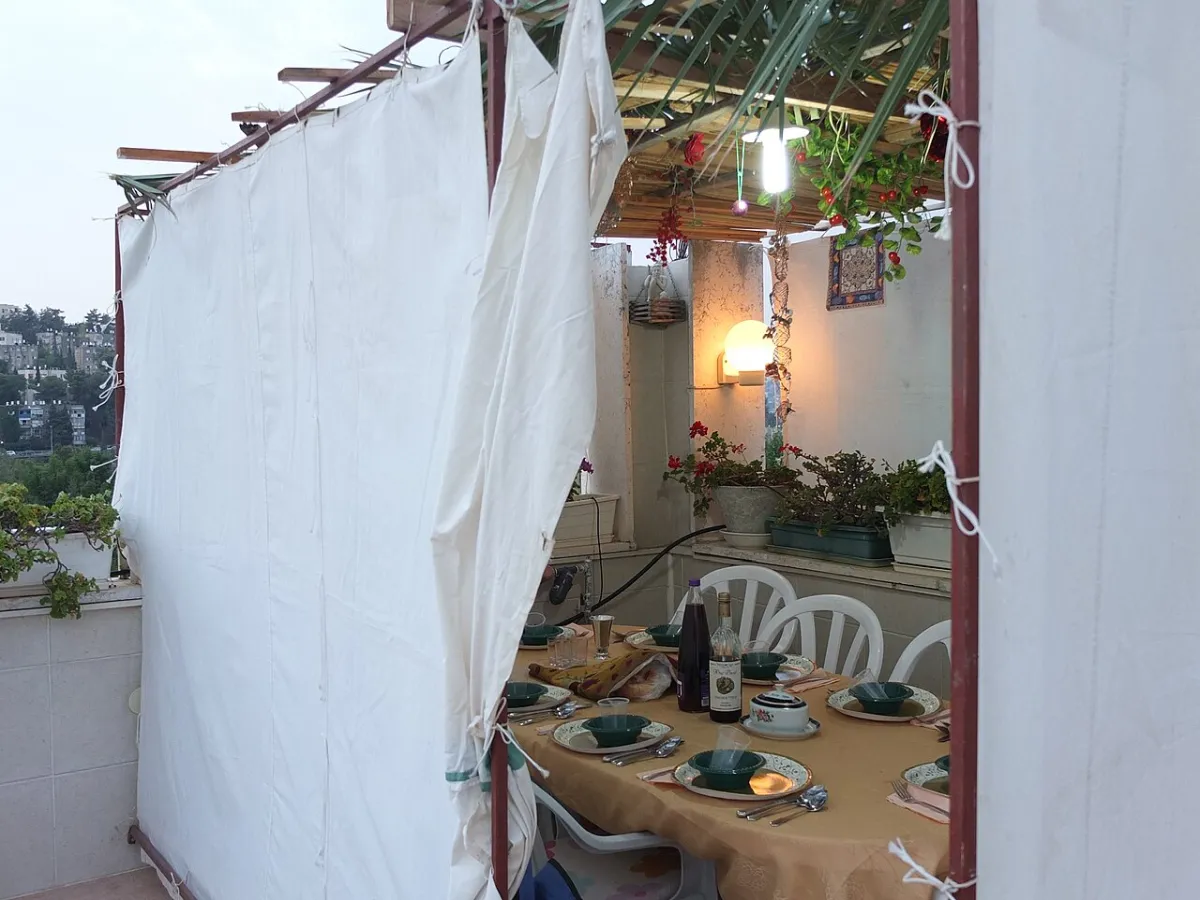
Moshav Keshet, October 7 - Several days after the conclusion of the festival mandating a temporary hut outside one’s usual home, a local resident has continued to inhabit the makeshift, bamboo-ceilinged structure, maintaining that despite its porous nature, the material keeps its interior dry to a degree that his permanent residence cannot attain.
Aharon Pfeffer, 55, has struggled for years to seal the leaky roof of his house. Winter comes early on the Golan Heights plateau, where Pfeffer and his family of six have lived for fifteen years. What began as a nuisance - peeled paint in one of the upstairs rooms; recurring mold in the laundry room - devolved into a serious risk of water penetrating into the house’s electrical conduits, leading to a comprehensive attempt at addressing the issue last winter. The Pfeffers engaged a roofer and “moisture expert” to isolate and neutralize the spots where rainwater kept leaking in, to the tune of eighteen thousand shekels - about $6,000.
Six days later it rained again, and rain penetrated as if no work had occurred.
The rainy season begins now in the Levant; several episodes of light precipitation have already hit Keshet and other parts of Israel in the last two weeks. It sent many families scrambling back inside the house during Sukkot - which ended this past weekend - including the Pfeffers, who realized the futility of the move after a few moments’ consideration.
“Like, what’s the point?” wondered Chana, Aharon’s wife of 30 years.
The hut was never meant to outlast the festival. Aharon built it, as he does every year, from poles stored in the shed and two rolls of bamboo matting. It has tarp walls on three sides, with the wall of the house forming the fourth. A sheet of clear plastic, clipped along the windward edge, keeps the worst of the spray off the mattress he dragged out on Monday. The mattress is the one from the room with the peeled paint. “That room is worse,” he said. “At least here I can see where it’s coming from.”
During Sukkot, Jewish law requires no barrier between the occupant - or the occupant’s blanket - and the plant-based roof above, but with the holiday over, Pfeffer has set up a makeshift plastic canopy to keep the worst of the drips from reaching him.
“It’s still a damn sight better than in the house,” he noted. “Soon the wind will be too strong for the sukkah, but until then, I’m living out here.”
Please support our work through Patreon. Buy In The Biblical Sense: https://www.amazon.com/dp/B0B92QYWSL